7.18.2012

The Places in Murakami's Novels


The New York Times has published a combo photo-audio-passage page about the places in Tokyo that Murakami writes about in his novels. The one above is the Metropolitan Expressway 3. His new novel, IQ84, opens on this expressway as taxi is caught in a traffic jam. Murakami writes:

The taxi’s radio was tuned to a classical FM broadcast. Janacek’s ‘Sinfonietta’ -- probably not the ideal music to hear in a taxi caught in traffic. The middle-aged driver didn’t seem to be listening very closely, either. With his mouth clamped shut, he stared straight ahead at the endless line of cars stretching out on the elevated expressway, like a veteran fisherman standing in the bow of his boat, reading the ominous confluence of two currents. Aomame settled into the broad back seat, closed her eyes, and listened to the music.”

Go here to see a similar combination for:

Jingu Stadium and What I Talk About When I Talk About Running
Jingu-Gaien—a favorite Murakami running route from the running book
Denny’s and After Dark
Hotel Okura and IQ84
Kanagawa Prefecture and Gene Pitney’s Town Without Pity
Kinokuniya Books and his running book
Prada Store and IQ84
Aoyama Itchome—a subway station—and Hard-Boiled Wonderland & The End of the World
Nakamuraya Café and IQ84


7.16.2012

What Time Is It?


“What is time? If no one asks me, I know. If I wish to explain it to one that asketh, I know not.” St. Augustine

How often do you wonder what time it is? Time rules much our life. Time to go to bed, time to get up, time to get to work, time to have dinner, time to call it a day. And most of the time we really have a pretty fair idea what time it is.

Unless we are suffering from jet lag, we generally know when to eat and when to sleep. And that is what I am experiencing now, having returned from Italy to the West Coast. The flight took a fair amount of a day. The adjustment is going to take a fair amount of a week or two.

It is said that you need one day to recover for every time zone you travel through. That means nine days for me. Based on previous experience, I think that’s about right. I begin to wonder if the trip is worth it after all.

I find the west-east trip (Portland to Florence) doesn't cause much of a problem, hardly any, in fact. That’s odd given the reports of most other travelers. Perhaps it’s the pleasure of being back in Florence that does the trick. There is light, there is sun, the sky is blue. My clocks click in to Florentine time almost immediately.

On the other hand the return trip, east to west (Florence to Portland) really does me in. I’ve no idea why there is this difference. It’s still the same crossing of 9 different time zones. It isn’t that it may be grey, perhaps rainy, cloudy most of the day. Even when it’s sunny, as it can be in July and August, I experience a prolonged period of jet lag.

I don’t think age has much to do with it. It has always been uncomfortable. I just have to follow the routine, jet lag or not, and then eventually it will disappear. What it has to do with is the way we tell time. We tell time by our internal clock and we tell time by our psychological clock.

Our bodily rhythms, circadian rhythms and some say, our genetically determined temporal blueprint, govern our internal clock. Our daily routine and social schedule and obligations govern our psychological clock. These two types of clocks run fairly automatically and we don’t spend a lot of time thinking about them.

But now these two time-controlling systems are radically askew to put it mildly, “fucked up” as Katherine Schulz wrote in her review of Till Roenneberg’s Internal Time: Chronotypes, Social Jet Lag, and Why You’re So Tired.

When it’s time to get up here in Portland, it’s early afternoon in Florence. Who wants to have breakfast then? When it’s time to go to bed in Portland, it’s early morning in Florence. Who can sleep then? No one. It is miserable.

For me sleeping through the so-called night is the worst part of jet lag. The other commonly attributed symptoms—headaches, disorientation, memory loss, depression, digestive problems, irritability—never bother me. Fatigue and sleep deprivation do.

By the end of the day, I am so utterly exhausted that I usually fall asleep at once. But after sleeping for perhaps an hour or two, I’m up the rest of the night. By morning, I’m a wreck. I want to work; my body wants to sleep. After lunch, I try to nap, but then it’s early evening in Florence, and I haven’t the slight ability to nap then.

And it goes on like this for days. Eventually the disjointed craziness disappears, and I forget about all this discomfort by the time the next summer rolls around and Italy beckons once again.

7.12.2012

Archeology of The Present


For her next project, Maria took a temporary job as a chambermaid in a large midtown hotel. The point was to gather information about the guests, but not in any intrusive or compromising way. She intentionally avoided them in fact, restricting herself to what could be learned from the objects scattered about their rooms. …It was an archeology of the present, so to speak, an attempt to reconstitute the essence of something from only the barest fragments: …Paul Auster Leviathan

Their names were Carla and Roberto. I learned this from the welcome sign in the kitchen. I also knew that Moretti is their family name. That was the name on the Post-Its that I found in one of the drawers. Professor Roberto Moretti. Maybe Professor Carla Moretti too.*

A few years ago I stayed in their apartment in Florence and came to know them in this rather indirect fashion. Each day I learned something more and each time I looked at something that I thought I had seen before, I realized it was something new. One day I noticed there were psychiatric journals in the upstairs family room. Maybe Professor Moretti was a psychiatrist. Or maybe Carla was and they shared an office together.

I was not surprised that Roberto and maybe Carla were professors. The number of books in their apartment was enormous. In practically every room, there were floor to ceiling bookcases full of learned texts in music, art, philosophy, literature and several major reference sets and collections of fine editions. In the music room, there was also a grand piano. Perhaps that was Carla’s. Or maybe they both played the piano. That was more likely from the looks of things around there.

Most of the books, however, were literary masterpieces--all the classic novels, many contemporary ones from every nation, all beautifully bound in Italian editions. I looked about this place and asked: Have they really read all of this stuff? I also bemoaned the fact that I did not know Italian. Ces’t la vie.

“…it was fascinating to see the different ways people arranged themselves, and how much you could infer about their lives from a few objects.”
Peter Stamm Seven Years

What can one learn about a person from the place they live in, by looking at the objects they have put on their shelves and in their drawers, as well as the photographs and paintings that they put up on the walls? They are the traces of their life that they have left in their home, traces that reveal a great deal about anyone in any place or time. The traces are real, they are brought into their homes and put somewhere by someone. They are not secondary accounts, or someone’s recollections, or something you might be told if you asked about them.

This place clearly belonged to a learned family. I had no idea how old they were, but that was not important. I knew they had a family, or at least two children, whose beautifully framed photographs were hung on the walls of their bedroom.

Their daughter was shown at various stages of her life, from a young child, through adolescence and as mature women. She was in a reflective mood in one photograph. Her dark eyes were framed by equally dark shoulder length hair. Her wide forehead and full lips told me that she would not be easily swayed.

Nearby were three photos of what must surely was her brother. He was also shown at various stages of his life. In the most recent he had a full head of curly hair, was wearing glasses and appeared to be a most studious fellow just like everyone else in this family.

There was also a picture of a nicely dressed young man and woman, caught in an informal embrace. They were smiling and I thought was surely Carla and Roberto around the time they were married. What a handsome couple they were! They reminded me a bit of how my wife and I looked when we were setting out together.

Their apartment is in the university section of the Florence, although I thought they did not teach there. If they did, surely they would be living in the apartment. I sensed that there was more that was hidden from me.

Why didn’t they live there? Their apartment was furnished so beautifully, with a fully equipped kitchen, two bedrooms and ample space for entertaining. Perhaps they fell on hard times and had to move to more modest quarters. But then again, perhaps they simply needed a place that had more bookshelves.

* To protect their privacy, I have used fictitious names.

7.10.2012

A Free Bench

We spend our life trying to bring together in the same instant a ray of sunshine and a free bench.
Beckett, Texts for Nothing


The days drift by. The Florentine mood is peaceful. Being here is almost hypnotic, slightly soporific. At noon each day I take my bag lunch and sit out on a bench, more accurately a ledge attached to some of the classic Renaissance buildings.

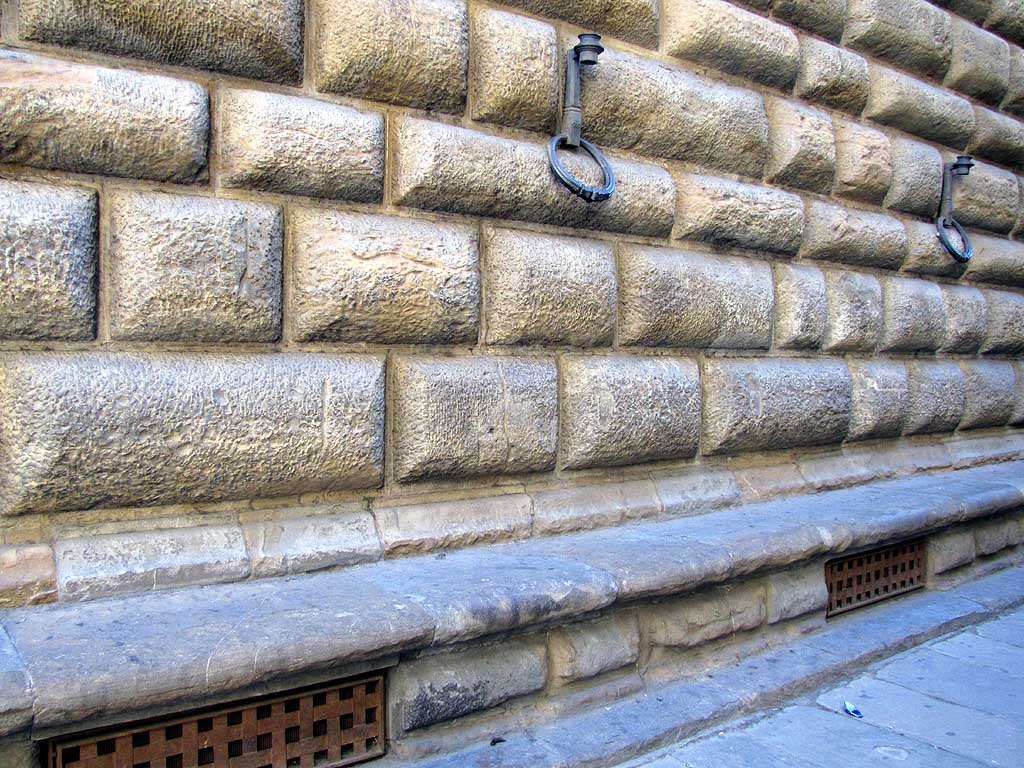
The Palazzo Ruccelai, shown above, was designed by the architect Leon Battista Alberti and built between 1446 and 1451. On either side of the two main doorways are long stone benches that run the length of the building. They served then, and still do, as resting places for the weary and occasional picnicker.

I stare at the people passing by and wonder about their life, where they are from, what they do during the day, and how they like it. The variation between them is enormous-the wealthy out shopping with their overflowing bags, the over-dressed, the simply dressed, the undressed. I think she could lose some weight, she is wearing too much makeup, how wonderfully thin she is, why doesn’t she look over this way, what does she see in him.


At breakfast several years ago I drank too much of the strong coffee they make around here and experienced what is known as a vasovagal reaction, a mild form of fainting. I desperately wanted to lie down and sleep for a bit. Frankly, I thought it might be the end.

Luckily I happened to be passing by the Palazzo Strozzi, a center of cultural events in Florence. The Palazzo is furnished on three of its sides with a large stone benches originally intended as a shady resting place for servants and the motley assortment of characters the palace attracted long ago. The bench now gives everybody a welcome opportunity to rest for a moment and let their latest vasovagal reaction fade away.

One day I penned a little poem about the bench I try to visit when I’m in Portland.

Across the street from my home and down about half a block
a bench has been thoughtfully placed beside the building.
I go there around teatime when the rains have passed
to sip my diet Snapple and linger in the sun.

I watch the cars go by and stare a little too long at the pretty girls
from the art school around the corner. It is my bench or so I like to think.
Sometimes another neighbor or passing stranger will come to sit beside me
and we may strike up a conversation which I do not mind at all.

But I do mind when the clouds are overhead and the rain is pouring down
upon the bench across the street from my home and down about half a block.
For then my bench and I must take our drinks indoors which is, I regret to say
most of the time around here.

7.06.2012

Studying Psychotherapy


From time to time one of my former students comes to see me when he or she is in Portland. It is one of the great pleasures of my life, especially when they go on to achieve the kind of success that the person who came to see me a few weeks ago day has.

Professor Jeffrey Berman was one of the first students who studied with me at Reed. I guided him on his senior thesis and Jeffrey was able to publish the results. Since then he has conduced a large number of influential studies on the effects of psychotherapy.

A great many therapists resist the experimental scrutiny of their practice. Nevertheless, Jeffrey forges on. He always has a new study to tell me about and no doubt it is a controversial one, in spite of its methodological rigor. In most cases, his research takes issue with one of the many current myths about psychotherapy.

Much of his research involves comparing the outcomes of different types of therapy, say behavioral, cognitive, humanistic, psychoanalytic, or “undifferentiated” counseling, etc. In the study we discussed in detail he compared the therapeutic effects of trained (professional) and untrained (paraprofessional) therapists.

Training programs are almost naturally assumed to be necessary for clinical success, that a trained therapist is bound to be more effective than an untrained one. Most of the prior research confirmed this assumption. However, Jeffrey found they were based on inappropriate comparisons and statistical analyses.

To avoid those problems he carried out a more selective comparison with stiffer methodological requirements. Unlike the previous studies he found that professional (trained) and paraprofessional (untrained) therapists were generally equal in client outcome effectiveness.

Further, there were no outcome differences for patient problems or for type of treatment or, finally, for treatments carried out individually or in groups. In a word, on these measures, trained therapists were no more effective than those who were untrained.

Of course, these findings are no better than the previous studies upon which they were based. And while they were chosen with great care, they were not original studies carried out by Jeffrey, research that is extremely difficult to conduct now. So in the end he had to fall back on a second order comparison, known as meta-analysis that has become the standard method of summarizing research findings but to some commentators has its own inherent limitations.

Nevertheless, his findings both surprised and pleased me; one more myth about psychotherapy falls by the wayside to empirical analysis. Of course, I was also pleased to hear about his research and how provocative it continues to be.

Recently, he has been returning to Reed each year, ostensibly for his annual class reunion. But I know it also reflects how much his years at Reed, his many friends, the great spirit of the place means to him. It is an ailment for which there is no cure, one that affects most graduates of this very special college.

7.04.2012

You Can't Be Neutral on a Moving Train


“People should go where they are not supposed to go, say what they are not supposed to say, and stay when they are told to leave.”
Howard Zinn

In 1994 I read Howard Zinn’s You Can’t be Neutral on a Moving Train. I know this from the passages I collected in my commonplace book 18 years ago.

I am quite distant from my copy of the book now and recall very little other than Zinn’s impassioned plea for equal justice in this country and the power of speaking out when it is denied. Since then, I have seen his films, read about him, and admired his life-long protests to insure genuine equality in this society.

Howard Zinn died early in 2010. I remember him on this July 4th and reassert the values we presumably celebrate today by citing some of the passages I recorded from You Can’t be Neutral on a Moving Train.

It is easy to mistake silence for acceptance.

I knew that the letter of the law was not as important as who held the power in any real-life situation.

The chain of relationships made me think of how connections are made—you read a book [Johnny Got His Gun, Born on the Fourth of July], you meet a person, you have a single experience, and your life is changed in some way.

The crimes of the rich and powerful go mostly unpunished.

Free speech? Try it and the police will be there with their horses, their bulbs, their guns, to stop you.

From that moment on, I was no longer a liberal, a believer in the self-correcting character of American democracy. I was a radical, believing that something fundamental was wrong in this country—not just the existence of poverty amidst great wealth, not just the horrible treatment of black people, but something rotten at the root. The situation required not just a new president or new laws but an uprooting of the old order, the introduction of a new kind of society—cooperative, peaceful, egalitarian.

…to relinquish the safety of silence.

I had always insisted that a good education was a synthesis of book learning and involvement in social action, that each enriched the other.

Going around the country, I was impressed again and again by how favorably people reacted to what, undoubtedly, is a radical view of society—antiwar, anti-military, critical of the legal system, advocating a drastic redistribution of the wealth, supportive of protest even to the point of civil disobedience.

We don’t have to engage in grand, heroic actions to participate in the process of change. Small acts, when multiplied by millions of people can transform the world.

What we choose to emphasize in this complex history will determine our lives. If we see only the worst, it destroys our capacity to do something. If we remember those times and places—and there are so many—where people have behaved magnificently, this gives us the energy to act…


7.02.2012

Americans in Florence

I don’t have the gift of entering into paintings as I do when reading a book. It isn’t that they leave me without a thought or two and some kind of vague appreciation of their colors and style.

But beyond that, I am at a loss for words and words are the only way I think and imagine, at least insofar as I am aware of. I feel very much like Edgar Logan in Jennie Erdal’s The Missing Shade of Blue.

At that point the language to interpret a painting was simply not available to me. …My eyes were innocent like those of a child, though to me they were simply crude and ignorant.


In spite of this, last week I went to see the exhibition, Americans in Florence, at the Palazzo Strozzi and hoped I could learn a little something about the many American painters who enjoyed their days here, as much as I do, and were suitably inspired to express their pleasure in the way they know best.

The exhibition featured the work of John Singer Sargent. Like many Americans who travel to Florence, they made a first stop in a local hotel. Here is how Sargent depicted one such room.

William Merrit Chase, less well known among the American Impressionists, usually preferred to stay in one of the many villas just outside the centro. Chase painted this picture of the Villa Silli before he bought it a few years later.

Many of Sargent’s paintings were portraits of the writers and artists who visited Florence. The British writer Vernon Lee (pseudonym of Violet Paget) known for her novels, essays, and travelogues, was among them.

Willard Metcalf, also not as widely known as Sargent, was among the several artists who painted the Tuscan countryside. Here is one he painted of Fiesole, located up in the hills above Florence. It is one of my favorite places to visit while I’m here.

Sargent’s painting of Henry James is often reproduced; perhaps you’ve seen it before. One reviewer wrote of this painting, His eyes, watery green, yet secret and profound will look at you, will touch and catch you intimately.

These are only a sampling of the exhibition’s paintings. It runs until July 15th, so there’s plenty of time to head over for a first-hand viewing. If you can’t make it, there’s an app of the exhibition available at the iBooks store.

6.28.2012

E-books Don't Smell


“The smell of a freshly printed book is the best smell in the world.”
Karl Lagerfeld

My iPad doesn’t smell and of course the e-books I read on the Kindle app don’t either. However my printed books do, a pleasure derived from my very first days of reading and one that I miss with those I read on an e-reader.

Printed books don’t smell the same either, a feature that broadens their pleasure. Age, paper, binding and cover contribute to these differences. It has been described this way:

The ink and chemicals used in the production of a book reacts with heat, moisture and light, causing the organic materials to break down. This is especially true for books with high acidity, like those made during the 19th and 20th centuries.

The books deep in the library stacks at the university where I went as an undergraduate smelled old, some a bit musty. The air circulation down there in those days was poor, it was hot, and dark. You had to switch a light on to find what you were looking for on the shelves.

That smell was quite different from those Bantam paperbacks I recall reading as a kid. Whenever I come across one of those paperbacks today, they still smell the very same way.

“When I open them,
most of the books have the smell
of an earlier time leaking out between the pages -
a special odor of the knowledge
and emotions that for ages
have been calmly resting between the covers.
Breathing it in,
I glance through a few pages before returning each book to its shelf.”

- Haruki Murakami (Kafka on the Shore)

Strangely, after all of these years, I’ve not forgotten the peculiar blend of paper, leather, and dust that I inhaled each time I stepped foot in the little neighborhood library of my hometown.

It is hard to describe odors in general and even harder to describe the various smells of books. We don’t have words for the wide range of odors that come our way even though the sense of smell is one of our most primitive.

Yet, it has been estimated that humans can distinguish thousands of different odors—aromas, fragrances, and scents. Though we can make such distinctions, we can attach a name to only fraction. However we can conjure up countless associations to the distinctive smell of books—the book we read on a park bench in Flore ce, or the one we read on the floor at Powell’s, another deep in the stacks of what is now known as the Green Library, etc.

If you miss the smell of e-books as much as I do, you will be pleased to learn that through the wonders of technology, our problems have finally been solved. Thanks to Smell of Books, you can now chose to give your e-books a distinctive smell with their “revolutionary new aerosol e-book enhancer.”

But wait there is more. You can now choose between five, no less, distinctive aromas—classic musty, crunch bacon, eau de cat, new book, and finally their five star aroma, sense of scent of sensibility.


You can also relax secure in the knowledge that “Smell of Books™ is compatible with a wide range of e-readers and 100% DRM-compatible. Whether you read your e-books on a Kindle or an iPhone using Stanza, Smell of Books™ will bring back that real book smell you miss so much.”

6.26.2012

Nora


“The amount of maintenance involving hair is genuinely overwhelming. Sometimes I think that not having to worry about your hair anymore is the secret upside of death.”
Nora Ephron

The death of Nora Ephron shocked me. How could someone so alive leave us? Yes, I felt it as a personal loss. For a brief moment in my life she was my friend. I recall our time together clearly. Permit me to recount it.

My first job was in a bookstore. The store was called Martindale’s after dear old Mr. Martindale, who along with his store in West Los Angeles is long gone. I must have been in Junior High at the time and so could not have been more than fourteen. Nora was slightly younger.

It wasn’t “your ordinary first job.” To this day I can remember the smell of the new books and the distinctive scent they created in that relatively small space. Even then I somehow knew the books, or thought I did, knew their titles, and authors. I could tell people what they were about and, without much of effort, get them to buy the book, and then one or two others along the way. I have utterly no idea how I was able to do any of that, especially at that time in my life.

It was the young girl who worked along with me that made that summer so unforgettable. Her name was Nora, the clever, sprightly Nora, well known for her literary and cinematic wit. I fell madly in love with her that summer at Martindale’s. Those who know her may be aware she is slightly cross-eyed. What young man could resist that?

But Nora could talk. She was clever, funny and bright. She was the first person I could ever really talk to. There have only been one or two others, many years later. As I recall it now, Nora and I spent the entire time bantering and jesting with one another. It is a mystery how we managed to get anything done or sell any books, or remember to give the proper change to those well-healed customers.

I am sure she has no recollection of me or our “brief encounter” at Martindale’s bookstore or probably even working there. But every time I hear about her or see one of her films, I remember the summer of my very first job. Books, magazines, paperbacks, and the beautiful cross-eyed girl who talked with me.

I never thought much about it at the time; after all, I was scarcely a teenager. All I knew was that I was crazy about Nora, but that was about it. I went back to school after that summer and only many years later, when Nora became well known, did I recall out time together and only recently have I begun to appreciate its significance.

This is how I will always remember her. Not for her films or books, although they were no different than she was. But our time together at Martindale's, when we were just kids.

6.24.2012

On a Morning Walk

The area around Florence is still my favorite: there is something special about the Tuscan light. Barack Obama, Corriere della Sera 7/8/10

Each morning I go on a long walk along the Arno. It is then that I find the light at its best. I walk across the river on one bridge and back across another. All told there are six bridges across the Arno in Florence.

At the Ponte Alle Grazie: Originally built in 1227, the Ponte Alle Grazie is the oldest of the bridges crossing the Arno and the longest. In 1944, it was, destroyed by the Nazis in retreat from the advancing Allied army. It was rebuilt in 1953.


A shady park along the River, a welcome spot on the hot sunny days. I go there to read on a bench in the afternoon.


Constructed in 1345 on the narrowest point of the river, the legendary Ponte Vecchio is the only bridge to have survived the invasion of German troops in 1944—said to be on orders from Hitler. Today there are shops along each side occupied by jewelers, art dealers and souvenir sellers.


The buildings along the banks of the Arno from the Ponte Vecchio. The range of bright colors on the buildings in Italy are unique of my experience and they are at their best in the bright morning light.


A treat in a café at the end of the walk.

6.21.2012

The Right Question


“She communicates largely by asking questions, not personal questions about his life or past history but questions about his opinions on topics ranging from the weather to the state of the world.” Paul Auster

Some people are questioners and others are not. To my knowledge the source of these differences has not been investigated. Leon Neyfakb writes about one teachers examination of this issue in his Boston Globe article, “Are We Asking the Right Questions?” I might title it “Are We Asking Questions At All?”

His article begins by describing a teenage classroom situation where the students have been reading Camus’ The Plague. The teacher asks them to generate as many questions about the novel as possible. Not to worry about answers, but simply the questions. Dan Rothstein, co-founder of the Right Question Institute in Cambridge is observing all this in the back of the classroom

Rothstein believes current the current educational curriculum has neglected to teach young children how to ask good questions. He says, “learning how to ask questions should be considered as critical as learning how to read, write, and do basic math.”

His Institute has a Blog, programs in education, health care, training programs in voter engagement and something the Institute refers to as Microdemocracy which it describes as “individuals using essential democratic skills to participate in decisions make in their ordinary encounters with public institutions.” One assumes that learning how to ask good questions is an essential part of all these programs.

Rothstein and his colleague Luz Santana have recently published their manifesto-of-sorts, Make Just One Change: Teach Students to Ask Their Own Questions. It makes two simple arguments:

All students should and can learn to formulate their own questions
All educators can easily teach the skill as part of their regular practice


What is a right question? It is hard to tell from either Neyfakb’s article or the material on the Institute’s website. It is suggested that choosing the right question involves a trade-off between clarity and depth. But what distinguishes a right from a wrong trade-off?

In response to an invitation to write the Institute should we wish to know more, I wrote to seek clarification of what, in fact, a “right question” is. The Institute gives itself that name. Surely it means something. Is it simply a good question? Why not then, The Good Question Institute? I’ve never had a reply.

While asking questions is critically important, one never knows what the right one is until you obtain an answer. For example, if your question solves an important problem, moves the issue forward, leads to further questions that bring you closer to a solution, etc. then it is the right one for that time.

Whether you can change an unquestioning person into a questioning one remains on open question. Starting with teenagers is surely worth the effort, but I think individuals at any age could benefit from such instruction.

It is asking questions, showing curiosity, and inquiring genuinely that is important to me and to Rothstein. He has put his conviction into action. I praise him for that.

6.17.2012

A Florentine Tradition


In contrast to the Dickensian grime, smoke, and smog, to all the noise and confusion that characterized the modern city, there was the peaceful sunlit Florence of the Renaissance—a simpler, purer, more harmonious “magic city” of art and music, learning and piety, strength and beauty. Walter Kaiser

I went out for a long afternoon walk on my first day in Florence. In no time at all the sound of trumpets and rolling drums greeted me. The rhythmic beat came from a group of Florentines dressed in the traditional Renaissance costume of their neighborhood. In turn, they were followed by groups of men from other neighborhoods dressed in their distinctive costumes.


The parade went on for a good half hour as the marchers moved slowly down the crowded street from one end of town to the other. The ancient tradition lives on. This is the way it has always been in Florence.


The main event takes place in piazza in front of Santa Croce Cathedral, where the large, rectangular area has been heavily sanded and ringed with bleachers. It is there that the legendary Calcio Strorico takes place, as it has in various piazzas of Florence for over five centuries.


It is a brutal event involving soccer, rugby, and fierce fighting between the teams from each of the neighborhoods. A commentator put it this way: “Equal parts show and sport, the festivities surrounding this ruthless competition incorporate Renaissance folk traditions and garb.”

Tradition aside, it became so brutal recently that it was banned last year. They will try again this year.


6.15.2012

Summer Sojourn


Marks in the Margin is going on a summer break for a while. Postings, if any, will be intermittent.

In the meantime, you are welcome to browse the archives. Know that your comments are always appreciated

As usual at this time of the year I wish you much good reading.

6.13.2012

A Graduation Letter


All changes, even the most longed for, have their melancholy; for what we leave behind us is a part of ourselves; we must die to one life before we can enter another. Anatole France

In a interview in the Times (5/27/12), the president of Harvard, Drew Gilpin Faust, was asked, Is there any book you wish all incoming freshmen at Harvard would read? She said it would be Kathryn Schultz’s recent book, Being Wrong, suggesting it “advocates doubt as a skill and praises error as the foundation of wisdom.”

I thought for a long time about this question. Would book would I recommend to incoming students to any college? It was a good question, even though the interviewer limits it to one.

This fall my grandson will be entering the freshman class at Penn. Along with a letter, I am giving him Ann Patchett’s What Now? It’s not because I think all freshmen at Penn or any other college should read it, but that the questions it poses are relevant to anyone at any time in their life.

However, in a way, What Now? is not unlike Schultz’s Being Wrong. Both stress the importance of remaining skeptical, being open to alternatives, and contrary information, whether in the form of factual evidence or personal experience. It is also a short book and like so many other freshmen these days, he doesn’t read a great deal outside of class.

He is a very fine soccer player who the Penn soccer coach invited him to enroll at Penn. And so in my letter I began by quoting legendary soccer star Romario who said recently, “The tendency of everyone is to evolve.”

I put side-by-side two photos one of me, when I graduated from high school in 1954 and one of him. I asked him to look at me now and wrote: Do I bear any resemblance to that graduating senior in 1954? I said, think how you look now. Imagine what you’ll look like or be thinking about in fifty years or so.

I wrote about how change rules our life, change in appearance, change in ideas, change in what you regard as important. We evolve as a result of the colossal number of events and experiences we have in our life, to say nothing of the aging process itself. I admitted I have no idea how I was able to do the things I did even twenty, thirty of more years ago or if any of it actually happened, let alone to me.

I told him what it was like when I entered college what a momentous experience is was for me, how it that changed my life forever. I hoped that he would be similarly affected by his days ahead at Penn. Wistfully I wrote, “I envy you so much now. How I wish I could do it all over again. You will have to do it for me.”

Like every graduation speaker, I passed along a word of advice by urging him to make the most of his days at Penn. “You’ll never have a chance to repeat them. Take them where it leads you, even if it is far from where you begin.”

I said there was much wisdom in Patchett’s suggestion, “Identify your heart’s truest desire and don’t change that for anything.”

And I concluded by writing, “Know, however, that your “truest desire” today many not be the one you’ll have tomorrow. So whatever your plans are, be open to changing them. That’s what I did and, for that, I remain forever grateful.”


6.11.2012

The Girl Who Fell From The Sky


What they were about to do defied all knowledge, all common sense, and yet she felt only a great rush of excitement.

Anne-Marie Walters was one of the thirty-nine women agents of the British Special Operations Executive (SOE) who were sent into occupied France during World War II. These agents worked with various groups of the French Resistance providing intelligence, sabotaging German facilities and trains and assisting downed Allied airmen to return to England.

Their work was fraught with danger. Twelve of the 39 were captured and murdered by the Germans, one died of meningitis, while the remainder survived the war. Anne-Marie was one and wrote about her experiences in Moondrop to Gascony. Her friendship with the mother of the British writer, Simon Mawer led to his interest in the women who served in the SOE. Walters is the subject of Mawer’s The Woman Who Fell From the Sky (published in the US as Trapeze).

Part fiction, part fact, Mawrer’s novel is an account of what it was like to serve as an agent in Nazi occupied France. The activities of the men and women of the Resistance is both inspiring social history and one that never ceases to command my respect knowing that these individuals worked day and night, usually alone, under the constant threat of capture and its terrifying consequences.

The novel begins by introducing Marian Sutro whose mother was French and father English; Marian speaks both languages fluently. As a result, she comes to the attention of an SOE recruiter, is sent to Scotland for training where she learns espionage, surveillance, wireless operation, and how to survive behind enemy lines. The training is grueling.

Always assume the worst, one of the instructors warned them: a pessimist makes the best agent.

She is parachuted into France, becomes Alice for a while, and begins work with the resistance. Eventually she is asked to go to Nazi infested Paris where there is no safety. Her task is to deliver an important letter to a French atomic scientist, once her teen-age infatuation.

The letter is from a professor in England. To read the letter, he is given a key. Alice tells him he can open up a minuscule compartment and take out a microdot. A microscope is required to read the embedded letter. Clever! It is persuasive, describing the work of German scientists to develop an atomic bomb.

Alice arranges his escape to England, finds herself unable to join him on the pick-up plane, manages to elude her followers, and returns to the relative safety of the countryside.

Does she return to England to join her former lover, remain in France to carry on with her resistance work, or fall prey to Nazi captors? These questions will not be answered here. Mawer’s account is captivating, fast paced, full of surprise, ingenuity, and suspense.

Once in a while I read such a thriller. I read The Girl Who Fell From The Sky because it is a story about the French Resistance, one of those events where I ask myself once again how I would behave if I were placed in a similar situation. Would I be able to display such courage? It is as simple and unknowable as that.

What are you going to decide? Because you’ve got to make a choice. That’s one of positive thing that this war has brought: we have to choose.

6.08.2012

The Missing Shade of Blue


Suppose there that a person…to have become perfectly well acquainted with colours of all kind, excepting one particular shade of blue…Let all the different shades of that colour, except that single one, be placed before him…Now I ask, whether it is possible for him, from his own imagination, to supply this deficiency, and raise up to himself the idea of that particular shade, though it had never been conveyed to him by his senses.
David Hume

We are in Edinburgh. Edgar Logan, a young man from Paris, arrives to translate the essays of David Hume. “…most of my life has been spent in books, reading other people’s stories, living vicariously through characters that don’t exist.”

Early on he meets the, bitter, physically crumbling, soon-to-be-dismissed-philosophy professor, Harry Sanderson and his enigmatic wife, Carrie. “Up until then I lacked the talent for friendship. Later I would sometimes wonder what it was about the Sandersons that made the difference, what it was the sucked me in…”

This is how Jennie Erdal begins her novel, The Missing Shade of Blue. It engrossed me from the first page. Several threads are interlaced throughout her tale.

On David Hume: Hume had not set out with the intention of being an unbeliever. Rather he had followed the arguments for religion and them wanting. He was a man primarily interested in explaining our place in the world so that we might live better lives; and the art of living well, he soon discovered did not sit happily with clinging on to illusions.

On philosophy: The unexamined life is much despised. According to Socrates, it is not worth living. But actually, the examined life can get you into all sorts of trouble.

On painting: At that point the language to interpret a painting was simply not available to me. Later Carrie would tell me this was an advantage. My eyes were innocent like those of a child, though to me they were simply crude and ignorant.

On vicarious experience: Nearly all of my experience of life—the highs and lows, the hopes and disappointments, the chaotic entanglements—everything that matters in fact—all of this has been mediated through the written word. With the result that novels have given me the sense—the illusion perhaps—of a connection with others, with the texture of real lives.

On marriage: My close reading of fiction had taught me that nearly all marriages occupied strange territory. But it was more vivid and startling to see it with you own eyes.

On happiness: …happiness often reveals itself as counterpoint. It is edged about with things that are opposite to it.

On novels: …a good novel was like a small miracle…fiction allowed us to live lives of other than our own….And every so often, I said, something emerged from a novel that could only be called truth—there was no other name for it. Which has a paradoxical ring to it, since of course, fiction is made up, full of lies.

These are but a fraction of the passages I noted in The Missing Shade of Blue. Is there a story along with Erdal’s philosophical ruminations? Yes, but on my reading, it plays a minor role. There is the tragic deterioration of a once fine philosopher and an emerging relationship between the Edgar, the translator and Carrie, the painter.

A Philosophical Adventure is the subtitle of The Missing Shade of Blue. That it is, the kind of book I am forever searching for. I found it one of those “small miracles.” For a philosopher, it will be a fictional treat. For a translator or painter, it is an endless debate. For any reader, it is a rich dialogue on Hume, happiness, friendship, language, and should you be the least bit interested, fly-fishing.

6.06.2012

On My Mind

Page Turner
The New Yorker has come alive again. Not on the printed page, although at times there is a really fine short story or literary commentary, but on the Web in the form of a new blog called Page-Turner. It first appeared on May 15th, after the magazine’s former book blog, the Book Bench, had been languishing in the doldrums for months.

In introducing Page-Turner Sasha Weiss writes: “Walking the halls of The New Yorker, one hears conversations about books trailing out of office doors…Page-Turner is an elaboration of this ongoing conversation.”

Recently Salman Rushdie wrote on censorship, Giles Harvey on the Death of a Salesman, Richard Brody on Susan Sontag’s writings about cinema, the Fifty Shades of Grey trilogy, interviews with the writers, Lorie Moore and Maile Maloy about their short stories, along with the daily list of Book News and the weekly posting by some of the staff on what they are currently reading.

Page-Turner has also inaugurated a series where writers are asked what book they have revisited most often. What a good question. Maile Melody who wrote the first response, said it is Salinger’s Nine Stories. What is yours?

A Better Person
At the gym I was listening to my first audiobook. It was read and written by Ann Patchett. And it is about her marriages and views on marriage, in general. Naturally, I was not aware she had quite so many lovers and more than one marriage.

She described a situation where she was talking to a friend about her disastrous first marriage and another person she loved deeply. She was pondering his frequent marriage proposals; they had been together for eleven years, no less.

Her friend asked her a a question you don’t often hear, a really good question, I thought. So did Ann Patchett. Her friend asked her does your new love make you a better person.

I stopped the tape there. I had to remember that question. It is a good one to think about it. I realized the question not only applies to your husband or your wife but to any person you know, any friend. Does the person make you a better one? And vice versa?

Hyperlinks
The other day I was reading the New Yorker on my iPad when I came across an advertisement for a book. I was informed that if I clicked on a link at the bottom of the ad, I could read an excerpt. I thought, how clever, perhaps the first time I had seen a hyperlink in an advertisement, at least in the digital version of the magazine.

I clicked on the link, skimmed a page praising the book, read several pages from the first chapter, and found the material not uninteresting. I was then informed I could click on another link to see a video of the author talking about the book. Fancy that, I thought.

Yet another link took me to a group of online bookstores where I could buy the printed version of the book. Finally, one more link took me to a comparable group of bookstores where I could purchase the e-book version. That was it. No more links. No more clicking. Back to the magazine, I went.

How remarkable all this was. Then I wondered if all of this could be done with a paper version of a book or magazine for that matter. Yes, I think I read about it somewhere. Then I wondered if any of this mattered. Did I learn a little about the book? Yes. Did I buy the book? No.

Besides, I don’t much care for hyperlinks in any text, paper or electronic. They do little else but distract me. My preference is clearly on the side of a footnote or set of references at the end, where I can be distracted when I want.


6.04.2012

Engagement With The Text


The debate over the relative merits of reading electronic and printed books continues. It is not an idle one, as several issues are involved—comparative learning, retention, pleasure, cost, convenience, etc. Most commentators acknowledge a certain degree of uncertainty about the mater.

Not Tim Parks, who last year claimed that reading on the screen is superior to reading on paper. After describing the well-known benefits of e-books—purchase text instantly, pay less, save trees, and carry around countless volumes, etc.—Parks moves beyond these features to the nature of the reading experience itself.

“The e-book… would seem to bring us closer than the paper book to the essence of the literary experience. Certainly it offers a more austere, direct engagement with the words appearing before us and disappearing behind us than the traditional paper book offers, ... It is as if one had been freed from everything extraneous and distracting surrounding the text to focus on the pleasure of the words themselves. In this sense the passage from paper to e-book is not unlike the moment when we passed from illustrated children’s books to the adult version of the page that is only text. This is a medium for grown-ups.”

Who is Parks referring to? I am not sure he is speaking for anyone but himself. Can he present supporting argument and evidence for claiming a reader is more engaged with an e-book than its printed counterpart?

As for myself, no matter how often I read an e-book, I always feel something is missing. What is missing is the print-book’s ease of writing notes, marking passages, as well as all the physical features of the printed book itself that I have grown used to and quite frankly mean a lot to me.

Taken together the experience of reading a printed book brings me closer to the text, heightens my reading experiences, and deepens it if you will. I can turn back and forth between pages, not a feature that is easily carried out on an e-book, think further about the passages I mark, make further notes and I can do this any time I go back to the book on my shelf, which I do a lot and never do in an e-book

I realize some of these behaviors can be performed on an e-book but for me doing that barely approximates carrying them out on the printed page. No doubt I’m “old school,” too fixed in my ways to change a life long pattern reading. On the other hand, I am aware that many far younger readers, including students reading academic texts, find e-books an undesirable alternative to those clunky, heavy, extravagant printed texts.

A fellow blogger replied to comments about Parks’ article by suggesting a serious engagement with the text can happen with any format, not just an e-book. And then she added: “I think most readers don’t really care as long as they have a good book to read.” I reply, “But it does to me.”

While research on this topic is in its early stages, what little we know suggests that there are major differences in the reading experience as a function of its format—print, online, e-reader, audiotape. Measures of retention, reader satisfaction, and neural processing, etc. seem to vary with each of these modes of presentation.

At the very least, anyone asserting one format is superior to any other should acknowledge the potential relevance of these findings, even if they do not influence their preferences. In an interview on this topic, Anne Mangen, an investigator at the National Center for Reading Research & Education in Norway, hit the nail on the head:

“I would say that the current shift from paper to screen represents a vast literary shift, the implications of which—short-term and, in particular, long-term—we are not yet aware of.”

6.01.2012

The Weather


The weather made her feel as if there was no point to life: whether you worked hard didn’t matter, whether you found someone to love didn’t matter, because even if you worked hard and found someone to love, a day like this would come, when a strange damp coolness seeped in through the windowpanes and seeped in through you, make you see that everything was meaningless. Brian Morton The Dylanist

June has arrived. Yet the cold and rainy weather continues around here. I cannot understand why it is so hard to remember the warm days of summer during these chilly, winter-like days.

I wonder if we could simply warm ourselves up by recalling those blistering days of August? We become sad by recalling times of distress. Why not warm by recalling those days by the pool in Tuscany?

To try I watch a film, Heaven, that takes place Italy. Italian is spoken in many of the scenes. Grim events occur in Milan and then the final third in Tuscany, in and around the hill town of Montepulciano.

It is the Tuscan countryside that always draws me back to the film--the dry rolling hills, the lone oaks on the hilltops, the long dirt roads to an old villa. It is warm, the light is clear, the colors vivid--yellow and orange--the mood is subdued and peaceful.

I recall a walk I took one morning when I was staying at a small medieval borgo in the heart of Tuscany. The sun was rising on yet another clear and warm day. There is nothing quite like the early morning light of a Tuscan morning. The path I took bisected two large fields of ripening grapes that led away from the borgo toward the main highway.

Small groves of olive trees were growing out in the fields and off in the distance I could see the bell tower of the village of Castelnuovo Bernardgna. It seemed too good to be true. Once again I felt so at one with the world. Not a person could be seen or heard.

My thermostat rises just a bit, even though the winds are blowing outside and the rain is pounding against the windows. I wonder if I will have to spend the rest of my life seeing films about Italy to get through the long winter around here. Probably.

I learn the DVD of Certified Copy arrived in the stores last week. I saw it in the theater and immediately plan to see it again since it also takes place during those warm summer days in Tuscany. It is also a brilliant film. Permit me an edited reposting.

In the New Yorker’s review, David Denby wrote that, “the movie celebrates marriage, which, after all, can be sustained only if it becomes a kind of narrative that a man and a woman create, develop, and vary as they go along.”


The film asks us to consider the difference between an original work of art and a copy? Can one put the same value on them? If not, why not? Does the distinction even matter? These questions become the central metaphor of the film.

It was written and directed by the Iranian Abbas Kiarostami. A woman, Juliette Binoche attends a lecture by an art historian, William Shimell. At the end of his presentation she goes to the podium to ask him a question, they converse for a while, and then she invites him to visit a nearby village in Tuscany with her.

Who could ask for more—an interesting question, two handsome actors, wandering through a Tuscan village? As they drive through the countryside, they continue to talk. The talk seems strange. It isn’t the sort of conversation you have with a stranger. You wonder if they might actually know one another after all, as she begins to flirt with him and then argue a bit. The owner of the cafĂ© assumes they are married.

What is going on? What does Kiarostami mean by all this lofty discussion and incongruous talk? You begin to interpret their conversation differently. You return to the original question. Are they re-enacting their marriage, creating a copy of the real thing? Is there a difference between the two?

You think perhaps they are married after all; perhaps they no longer live together. What fun to catch on, or to think you catch on. You have that “I get it” feeling. Is it obvious to everyone? It wasn’t to every moviegoer I spoke to about the film.

I thought this was cinema at its best. It is also fiction at its best—an amusing story against a background of provocative questions, peopled by brainy individuals, wandering about the villages and countryside of Tuscany. Again, my thermostat rises just a bit.


5.30.2012

Mind-Pops


Memory is a willful dog. It won’t be summoned or dismissed but it cannot survive without you. It can sustain you or feed on you. It visits when it is hungry, not when you are. It has a schedule all its own that you can never know. Elliot Perlman

My memory works in a fairly consistent way. When I can't remember something, I struggle without success to stop searching for it. This is the hard part. But it’s important to stop, if you want to recall what you’re searching for.

Finally I give up or get distracted and then, after an unpredictable amount of time, out of nowhere it seems, what I’m trying to recall drifts in. It can be in the middle of the night or when I am doing something else, like typing this sentence, taking a shower or not doing much of anything at all.

You just never know when X’s name will pop in. But more often than not it does--eventually—or I forget about what I was searching for. The mind does so much of its work behind the scenes.

Surely you have had similar experiences and I suspect the phenomenon is rather common. Mind-Pops is the subject of Ferris Jabr’s recent article in the Scientific American. Ferris reviews the work of Lia Kvavilashvii who is one of the few who have investigated this aspect of memory.

Kvavilashvili notes, “But once I started recording them, quite often I would notice that what popped into my mind wasn’t entirely accidental. The contents of the mind-pop had been experienced in the recent past.”

Another kind of mind-pop is the unexpected recollection of a previous event. The older you get, the more often this occurs. A childhood experience, a place you visited many years ago, a friend you haven’t thought of in years pops in. These memories are totally involuntary and seemingly unrelated to anything you are doing.

But are these autobiographical mind-pops quite so random? Perhaps they are related to something in your environment or an incident that “primed” them? Ferris writes, “If a psychologist gives a volunteer a list of words including the word “apple” and later asks the volunteer to write a complete word starting with “app,” the subject is more likely to write apple than “appetite” or “application.”

So perhaps the memory of having lunch many years ago with you high school buddy, Phillip popped in because recently you read a short story by Phillip Roth or a blog about him. Kvavilashvili believes that mind-pops are not random; instead they are linked to our previous experiences and knowledge.

She recalls a mind-pop when the word “Acapulco” sprang into her “consciousness.” after throwing a used bag into the trash, She couldn’t figure out why until a family member reminded her that 45 minutes before they had watched a TV program about the Mexican resort city.

Of course, most of the time the chain leading back to the source of the mind-pop cannot be traced. Still the fact that it often can suggests a mind-pop does not simply appear out of nowhere or represent random neuronal firings, even though the long chain of prior associations is not readily retrievable.

5.28.2012

Memorial Day Lanterns


At sunset on Memorial Day in Honolulu the tenth annual lantern floating ceremony will be held at the beach near Magic Island, not far from the center of Waikiki. The ceremony is held to honor the lives of those lost in war and to remember other “departed loved ones.”

Participants write the names of the deceased and their personal messages on paper lanterns, which are then set adrift onto the ocean. Each year more than 3,000 candle-lit lanterns are released into the sea.


While the ceremony is Buddhist in origin, Hawaii’s version reflects the Islands’ diverse collection of faiths and backgrounds. The ceremony I most recently attended featured everything from Hawaiian chant and hula to Japanese Taiko drumming, the Honolulu Symphony, and a German trumpeter.

At the conclusion of the ceremony, all the lanterns are collected from the ocean and recycled for use in the following years.


The event can be viewed on television or, in person, on one of the nearby beaches. Either way it is also a very moving experience.

5.24.2012

Friday Night Poetry


As I was walking by my bookshelf the other day, I noticed a book whose title looked interesting and whose author I may have heard of, but wasn’t sure.

I removed the book, read its title and turned at once to the inside back cover.

There I saw a set of numbers that I recognized as the pages where I had noted a passage or two.

But lo and behold, I had no recollection of the book, its author, story, or the slightest thing about it.

And then I recalled a poem by Billy Collins, an author I know, about an experience that is equally familiar to me.

Forgetfulness
The name of the author is the first to go
followed obediently by the title, the plot,
the heartbreaking conclusion, the entire novel
which suddenly becomes one you have never read,
never even heard of,

as if, one by one, the memories you used to harbor
decided to retire to the southern hemisphere of the brain,
to a little fishing village where there are no phones.

Long ago you kissed the names of the nine Muses goodbye
and watched the quadratic equation pack its bag,
and even now as you memorize the order of the planets,

something else is slipping away, a state flower perhaps,
the address of an uncle, the capital of Paraguay.

Whatever it is you are struggling to remember,
it is not poised on the tip of your tongue,
not even lurking in some obscure corner of your spleen.

It has floated away down a dark mythological river
whose name begins with an L as far as you can recall,
well on your own way to oblivion where you will join those
who have even forgotten how to swim and how to ride a bicycle.

No wonder you rise in the middle of the night
to look up the date of a famous battle in a book on war.
No wonder the moon in the window seems to have drifted
out of a love poem that you used to know by heart.


See Collins live performance at a recent TED conference:


5.23.2012

Schmidt Steps Back


No such thing as graceful old age. F. Scott Fitzgerald

There are novels that you want to write about and then there are others that leave you mute. While I finished Schmidt Steps Back, Louis Begley’s latest tale in his the sad saga of Albert Schmidt, it did little to stir my vocabulary.

But Schmidt bears a certainly similarity to me. We are both relics, relics from ancient times, ancient ways, and ancient ways of ruminating. Schmidt is now a widower, lives on the beach in the Hamptons, but is no longer the lover of the wild, 20 year old Puerto Rican waitress, Carrie, and no longer employed at his high-class legal firm either. What is he do with his life?

“I am a lonely old man I need to think I can make myself useful.”

He does this by becoming the director of the ultra, ultra billionaire Mike Mansour’s foundation that has established a series of Life Centers in European capitals to promote democracy. This takes Schmidt to Europe, almost weekly it seems, where along with promoting democracy, he has a cascade of affairs, and finally a serious lover who works for a publishing company in Paris. At this point the novel picks up a little steam. There’s nothing like a love affair in Paris, is there?

Mr. Mike Mansour is, quite frankly, even more interesting than Mr. Albert Schmidt. Mansour, an Egyptian Jew, is among the 1 percent of the 1 percenters. How he made his percents is never mentioned. But he is loaded.

Need a private plane to take you to Europe, a five star hotel in which to stay, an apartment should you wish to stay longer, for reasons that have nothing to do with democracy, meals at Michelin 5 rose restaurants, a town car, you name it? Pas de probleme.

As usual, in these tales, the strained relationship Schmidt has with his daughter, Charlotte, gives the novel a much-needed zing. At times she displays a cruel and malicious streak. Most of the time she ignores him. Schmidt counsels, “All I can say is that, as a general rule, it is more likely than not that something will go serious wrong between a parent and child. It’s such a fraught relationship.”

He does his best to love her, forgive her, regardless of her rejections and he is always on the ready to help her, probably too much on the ready. Later Charlotte falls into a deep and prolonged depression, requiring care and treatment in a psychiatric hospital all of whose costs Schmidt gladly pays. Sadly, their relationship never has a chance to end peacefully.

Most of the final sections of Schmidt Steps Back depict the on again, off again relationship with Alice, the irresistible Alice in Paris. We learn in great detail about their almost daily sexual encounters. You’d think for a man of 78, his adolescent passions would diminish a bit. But no, not for Schmidt for whom these experiences seem to be far more important than “being useful.”

At the end, there is some consolation for Schmidt other than merely staying alive. However, I am sorry to report this did little to enrich my pleasure in reading about his past reversals and current tragedies. Pas de probleme. I turn at once to The Missing Shade of Blue by Jennie Erdal, a novel that from page one onward is a philosophical tour-de-force.

5.21.2012

The Facebook Era


These days, social media continually asks us what’s “on our mind,” but we have little motivation to say something truly self-reflective. Self-reflection in conversation requires trust. It’s hard to do anything with 3,000 Facebook friends except connect. Sherry Turkle

It was the week of the big Facebook IPO fizzle. It was also the week I read a review of Facebook research recently published in Perspectives on Psychological Science, (Vol 7, 203-220). Even erudite scientific journals are not immune from the Facebook Effect.

The authors summarize the results of 412 studies from a variety of peer-reviewed journals. They report that Facebook now has over 845,000,000 (that’s 845 million) users from countries throughout the world. In fact, 80% of the users (Facebookers?) live outside this country. While I am aware of the popularity of Facebook (who could not be?) I didn’t realize it passed Google in 2010 to become the most visited website in the US.

The authors ask us to assume the activity of all these people on Facebook has some degree of generality to social behavior in other situations. They also ask us to assume the information shown in a user’s Profile is accurate, in other words, truthful. I am not sure about either of these assumptions.

The average user is reported to have 130 friends but the distribution on this measure is highly skewed, such that 20% had fewer than 25 friends, 50% had over 100 friends (Do you have over actual 100 friends?) and a small number had over 5,000—the maximum number allowed. I was intrigued to learn that 92% of the users were connected by only four degrees of separation from other users.

The question posed by the authors that interested me most was “Why do people use Facebook?” It sure beats me.

The most common reason cited in the research is the “users desire to keep in touch with friends.” This isn’t much of a bombshell, is it? Surely we knew how to do this before Facebook arrived on the scene. The researchers distinguish between strong ties—actively communicating with a small group of friends—and weak ties—more passive following the news of other “friends.”

A small number of studies suggest that loneliness may motivate some users, although the research here is equivocal. Others mention they become Facebookers to relive boredom, a motivation that seems more plausible to me, in the sense that it becomes a diversion, a time out, or a break from working on an effortful task.

The authors wonder if Facebook profiles are accurate. I don’t know how they expect to ever arrive at clear answer to this question without actually interviewing the profiler in person. In my case, to be sure only one, my profile was written in jest and while I am a pretty bookish guy, I do not look like the photo on my page. Anyone who knows me would realize in flash that I was only being playful about other matters, as well.

A great many commentators have worried about how Facebook affects a user’s personal relationships and especially for young persons, to what extent it interferes with their education. In the absence of research, the authors address none of these questions. Here we must fall back on the many published speculations and the accounts of individuals we know.

Does Facebook represent a positive contribution to society? The answer to this simple question is also beyond the scope of the report, probably beyond the scope of any systematic research. To answer this question, we might wish to imagine how our life would be different if there never was a Facebook in the first place. Would other forms online exchange fill up the void? Or what did we do before Facebook? Can we get along now without it?

In discussing the impact of Facebook on modern life, the authors suggest it played a major role in facilitating the Egyptian uprising that led to the overthrow of Hosni Mubarak. They claim that during the two weeks before Mubarak’s resignation, with five million users in Egypt, “over 32,000 new groups and 14,000 new pages were created on Facebook in Egypt.”

We have heard similar reports about other protest movements in the Middle East and the Occupy Wall Movement in this country. Again we must ask ourselves if these movements would have occurred in the absence of Facebook. To answer this question all we need to do is look to history for examples of protests and revolutions long before the Facebook Era.

At the end of his article, “Is Facebook Making Us Lonely?” in this month’s Atlantic, Stephene Marche concludes: “What Facebook has revealed about human nature—and this is not a minor revelation—is that a connection is not the same thing as a bond, and that instant and total connection is no salvation, no ticket to a happier, better world or a more liberated version of humanity.”