Showing posts with label Florence. Show all posts

6.29.2014

A Room With a View

All we knew was that we helplessly loved the place, and did not pause to ask why. C. Lewis The City of Florence

The apartment I’ve rented this year in Florence is located on the Lungarno Grazie, not far from the historical center of Florence. From its tall windows, I look out at the Arno, the hills across the way, dotted with trees and villas.


Higher up, I see the Piazza Michelangelo with is panoramic view of the entire city of Florence, the Brunelleschi’s Dumo and Giotto’s bell tower.


Even further up the hill is the Basilica of San Minato al Monte at one of the highest points in the city and is among the most beautiful churches in Italy.


On the other side of the Arno, down a few blocks, is a beautiful park, where I take a picnic lunch to each day.


It was always difficult, she said, to come home. She adored Italy. Apart from everything else, it was one of the few places where one’s hopes for the future could be restored. Beautiful, unspoiled fields and hills. Great houses that families had lived in for five hundred years. It was deeply consoling. Also the general sweetness of the people. James Salter All That Is

6.22.2014

Recycling in Florence


Not so long ago in Florence, you took your trash to big containers somewhere near your home or apartment. If neither of these were nearby, you simply tied the trash bag as tightly as you could and left it outside the door, where the collectors who routinely drove through the neighborhood would pick it up.

There isn’t anything like the big trucks that drive through the major metropolitan areas of this country to collect the trash and now some recyclables. In Florence the streets were never designed for trucks or for cars either.

It depresses me every time I realize what the cities of America were designed for.


However, throughout Florence now you begin to see these nifty recycling/trash collection containers. There are three types--one for organic materials, one for non-recyclables and one for recyclables.


A set of these containers is located just across the Arno from my apartment. A short walk across the Ponte Alle Grazie and I am there.

Florence is said to have the highest rate of recycling of any Italian city.

According to former mayor, now Prime Minister, Matteo Renzi: In Florence the cost of waste disposal is among the lowest in Italy; separate trash collection and separation has reached 47%, which becomes 65% with the new underground containers around the city and a massive 78% with the new San Jacopino ecological stations.

6.18.2014

Florence Parking Lot

Do you remember two lines of Joni Mitchell’s “Big Yellow Taxi”?

They paved paradise
And put up a parking lot.


Mitchell says she wrote the song during her first visit to Hawaii.

I took a taxi to the hotel and when I woke up the next morning, I threw back the curtains and saw these beautiful green mountains in the distance. Then, I looked down and there was a parking lot as far as the eye could see, and it broke my heart... this blight on paradise. That's when I sat down and wrote the song.

There is nothing like that, nothing close to that in Florence. Instead, gradually, street-by-street, the Centro is being closed to automobiles. Instead, this is what you are likely to see:


I took the photo as I was walking along the Arno one sunny morning. Off in the distance to the far left, is a section of the Ponte Vecchio, while closer to the left, behind the row of scooters, is the Museo Galileo.

7.12.2012

Archeology of The Present


For her next project, Maria took a temporary job as a chambermaid in a large midtown hotel. The point was to gather information about the guests, but not in any intrusive or compromising way. She intentionally avoided them in fact, restricting herself to what could be learned from the objects scattered about their rooms. …It was an archeology of the present, so to speak, an attempt to reconstitute the essence of something from only the barest fragments: …Paul Auster Leviathan

Their names were Carla and Roberto. I learned this from the welcome sign in the kitchen. I also knew that Moretti is their family name. That was the name on the Post-Its that I found in one of the drawers. Professor Roberto Moretti. Maybe Professor Carla Moretti too.*

A few years ago I stayed in their apartment in Florence and came to know them in this rather indirect fashion. Each day I learned something more and each time I looked at something that I thought I had seen before, I realized it was something new. One day I noticed there were psychiatric journals in the upstairs family room. Maybe Professor Moretti was a psychiatrist. Or maybe Carla was and they shared an office together.

I was not surprised that Roberto and maybe Carla were professors. The number of books in their apartment was enormous. In practically every room, there were floor to ceiling bookcases full of learned texts in music, art, philosophy, literature and several major reference sets and collections of fine editions. In the music room, there was also a grand piano. Perhaps that was Carla’s. Or maybe they both played the piano. That was more likely from the looks of things around there.

Most of the books, however, were literary masterpieces--all the classic novels, many contemporary ones from every nation, all beautifully bound in Italian editions. I looked about this place and asked: Have they really read all of this stuff? I also bemoaned the fact that I did not know Italian. Ces’t la vie.

“…it was fascinating to see the different ways people arranged themselves, and how much you could infer about their lives from a few objects.”
Peter Stamm Seven Years

What can one learn about a person from the place they live in, by looking at the objects they have put on their shelves and in their drawers, as well as the photographs and paintings that they put up on the walls? They are the traces of their life that they have left in their home, traces that reveal a great deal about anyone in any place or time. The traces are real, they are brought into their homes and put somewhere by someone. They are not secondary accounts, or someone’s recollections, or something you might be told if you asked about them.

This place clearly belonged to a learned family. I had no idea how old they were, but that was not important. I knew they had a family, or at least two children, whose beautifully framed photographs were hung on the walls of their bedroom.

Their daughter was shown at various stages of her life, from a young child, through adolescence and as mature women. She was in a reflective mood in one photograph. Her dark eyes were framed by equally dark shoulder length hair. Her wide forehead and full lips told me that she would not be easily swayed.

Nearby were three photos of what must surely was her brother. He was also shown at various stages of his life. In the most recent he had a full head of curly hair, was wearing glasses and appeared to be a most studious fellow just like everyone else in this family.

There was also a picture of a nicely dressed young man and woman, caught in an informal embrace. They were smiling and I thought was surely Carla and Roberto around the time they were married. What a handsome couple they were! They reminded me a bit of how my wife and I looked when we were setting out together.

Their apartment is in the university section of the Florence, although I thought they did not teach there. If they did, surely they would be living in the apartment. I sensed that there was more that was hidden from me.

Why didn’t they live there? Their apartment was furnished so beautifully, with a fully equipped kitchen, two bedrooms and ample space for entertaining. Perhaps they fell on hard times and had to move to more modest quarters. But then again, perhaps they simply needed a place that had more bookshelves.

* To protect their privacy, I have used fictitious names.

7.10.2012

A Free Bench

We spend our life trying to bring together in the same instant a ray of sunshine and a free bench.
Beckett, Texts for Nothing


The days drift by. The Florentine mood is peaceful. Being here is almost hypnotic, slightly soporific. At noon each day I take my bag lunch and sit out on a bench, more accurately a ledge attached to some of the classic Renaissance buildings.

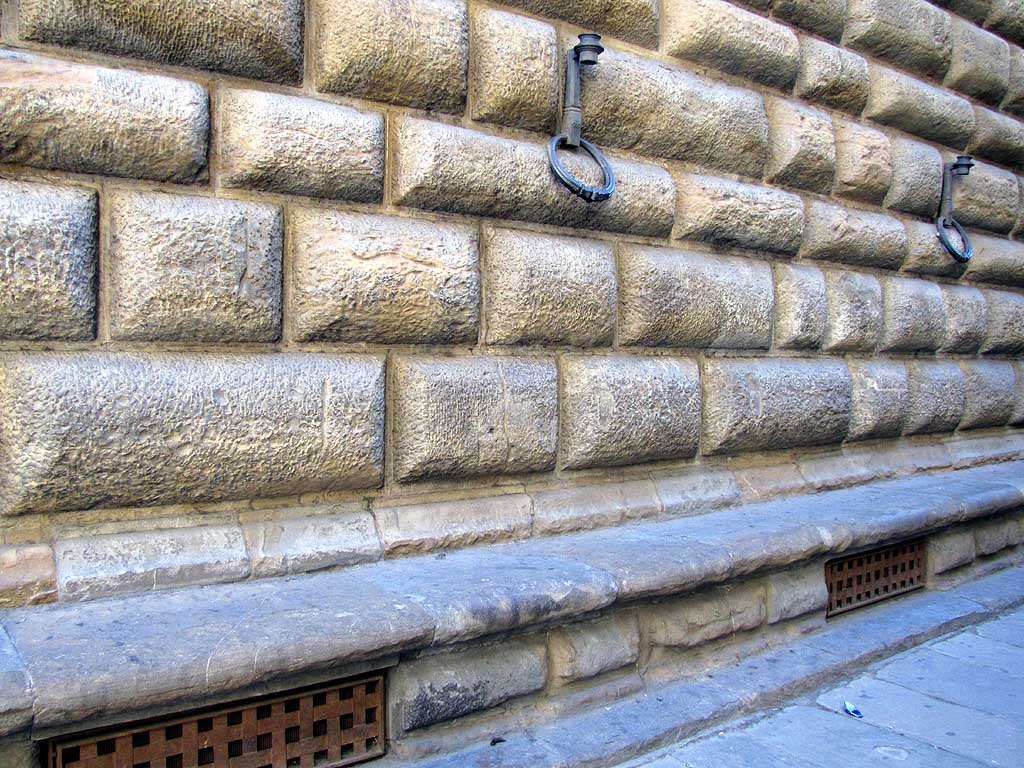
The Palazzo Ruccelai, shown above, was designed by the architect Leon Battista Alberti and built between 1446 and 1451. On either side of the two main doorways are long stone benches that run the length of the building. They served then, and still do, as resting places for the weary and occasional picnicker.

I stare at the people passing by and wonder about their life, where they are from, what they do during the day, and how they like it. The variation between them is enormous-the wealthy out shopping with their overflowing bags, the over-dressed, the simply dressed, the undressed. I think she could lose some weight, she is wearing too much makeup, how wonderfully thin she is, why doesn’t she look over this way, what does she see in him.


At breakfast several years ago I drank too much of the strong coffee they make around here and experienced what is known as a vasovagal reaction, a mild form of fainting. I desperately wanted to lie down and sleep for a bit. Frankly, I thought it might be the end.

Luckily I happened to be passing by the Palazzo Strozzi, a center of cultural events in Florence. The Palazzo is furnished on three of its sides with a large stone benches originally intended as a shady resting place for servants and the motley assortment of characters the palace attracted long ago. The bench now gives everybody a welcome opportunity to rest for a moment and let their latest vasovagal reaction fade away.

One day I penned a little poem about the bench I try to visit when I’m in Portland.

Across the street from my home and down about half a block
a bench has been thoughtfully placed beside the building.
I go there around teatime when the rains have passed
to sip my diet Snapple and linger in the sun.

I watch the cars go by and stare a little too long at the pretty girls
from the art school around the corner. It is my bench or so I like to think.
Sometimes another neighbor or passing stranger will come to sit beside me
and we may strike up a conversation which I do not mind at all.

But I do mind when the clouds are overhead and the rain is pouring down
upon the bench across the street from my home and down about half a block.
For then my bench and I must take our drinks indoors which is, I regret to say
most of the time around here.

7.02.2012

Americans in Florence

I don’t have the gift of entering into paintings as I do when reading a book. It isn’t that they leave me without a thought or two and some kind of vague appreciation of their colors and style.

But beyond that, I am at a loss for words and words are the only way I think and imagine, at least insofar as I am aware of. I feel very much like Edgar Logan in Jennie Erdal’s The Missing Shade of Blue.

At that point the language to interpret a painting was simply not available to me. …My eyes were innocent like those of a child, though to me they were simply crude and ignorant.


In spite of this, last week I went to see the exhibition, Americans in Florence, at the Palazzo Strozzi and hoped I could learn a little something about the many American painters who enjoyed their days here, as much as I do, and were suitably inspired to express their pleasure in the way they know best.

The exhibition featured the work of John Singer Sargent. Like many Americans who travel to Florence, they made a first stop in a local hotel. Here is how Sargent depicted one such room.

William Merrit Chase, less well known among the American Impressionists, usually preferred to stay in one of the many villas just outside the centro. Chase painted this picture of the Villa Silli before he bought it a few years later.

Many of Sargent’s paintings were portraits of the writers and artists who visited Florence. The British writer Vernon Lee (pseudonym of Violet Paget) known for her novels, essays, and travelogues, was among them.

Willard Metcalf, also not as widely known as Sargent, was among the several artists who painted the Tuscan countryside. Here is one he painted of Fiesole, located up in the hills above Florence. It is one of my favorite places to visit while I’m here.

Sargent’s painting of Henry James is often reproduced; perhaps you’ve seen it before. One reviewer wrote of this painting, His eyes, watery green, yet secret and profound will look at you, will touch and catch you intimately.

These are only a sampling of the exhibition’s paintings. It runs until July 15th, so there’s plenty of time to head over for a first-hand viewing. If you can’t make it, there’s an app of the exhibition available at the iBooks store.

6.24.2012

On a Morning Walk

The area around Florence is still my favorite: there is something special about the Tuscan light. Barack Obama, Corriere della Sera 7/8/10

Each morning I go on a long walk along the Arno. It is then that I find the light at its best. I walk across the river on one bridge and back across another. All told there are six bridges across the Arno in Florence.

At the Ponte Alle Grazie: Originally built in 1227, the Ponte Alle Grazie is the oldest of the bridges crossing the Arno and the longest. In 1944, it was, destroyed by the Nazis in retreat from the advancing Allied army. It was rebuilt in 1953.


A shady park along the River, a welcome spot on the hot sunny days. I go there to read on a bench in the afternoon.


Constructed in 1345 on the narrowest point of the river, the legendary Ponte Vecchio is the only bridge to have survived the invasion of German troops in 1944—said to be on orders from Hitler. Today there are shops along each side occupied by jewelers, art dealers and souvenir sellers.


The buildings along the banks of the Arno from the Ponte Vecchio. The range of bright colors on the buildings in Italy are unique of my experience and they are at their best in the bright morning light.


A treat in a café at the end of the walk.

6.17.2012

A Florentine Tradition


In contrast to the Dickensian grime, smoke, and smog, to all the noise and confusion that characterized the modern city, there was the peaceful sunlit Florence of the Renaissance—a simpler, purer, more harmonious “magic city” of art and music, learning and piety, strength and beauty. Walter Kaiser

I went out for a long afternoon walk on my first day in Florence. In no time at all the sound of trumpets and rolling drums greeted me. The rhythmic beat came from a group of Florentines dressed in the traditional Renaissance costume of their neighborhood. In turn, they were followed by groups of men from other neighborhoods dressed in their distinctive costumes.


The parade went on for a good half hour as the marchers moved slowly down the crowded street from one end of town to the other. The ancient tradition lives on. This is the way it has always been in Florence.


The main event takes place in piazza in front of Santa Croce Cathedral, where the large, rectangular area has been heavily sanded and ringed with bleachers. It is there that the legendary Calcio Strorico takes place, as it has in various piazzas of Florence for over five centuries.


It is a brutal event involving soccer, rugby, and fierce fighting between the teams from each of the neighborhoods. A commentator put it this way: “Equal parts show and sport, the festivities surrounding this ruthless competition incorporate Renaissance folk traditions and garb.”

Tradition aside, it became so brutal recently that it was banned last year. They will try again this year.


5.16.2012

Pop Quiz


1. What contains 100% recyclable materials?

2. Runs without a battery?

3. Can be used on take off and landing?

4. Can fall and not break?

5. Doesn’t require an Internet connection?

6. Opens quickly?

7. Is compatible for sun and sand?

8. Will never crash?


Times up. If you guessed a book, you may go to the head of the class.

The quiz owes its origin to the Paperback Exchange, an inviting bookstore in Florence, Italy. The questions appeared in an advertisement, The Ultimate Reading Device, the bookstore placed in Florence’s English Language newspaper.

The store is located on a typical narrow street near the center of Florence. Let’s go inside.

Places to read abound.
About once a week there is a reading, lecture, or recital.

There is one other English Language bookstore in Florence. Be ready for the next pop quiz. Hint: recently, it was almost forced to close.

8.03.2011

Aesthetic Experience


“I hardly think there can be a place in the world where life is more delicious for its own simple sake.” Nathaniel Hawthorne

I am often asked why I keep returning to Florence. In her novel The Cookbook Collector Allegra Goodman answers for me.

"You forget that some aesthetic experiences satisfy…There is such a thing as excellence, and I do know it when I see it, and when I find it I am fulfilled. I want to keep on hunting endlessly. If I’m restless, that’s not because I want to be or because I can’t help it. I am not chronically dissatisfied; I’ve been disappointed. There’s a difference. When I discover something beautiful and right and rare, I’m happy. I’m content."

That is precisely the way I feel about Florence. For me there can never be another place like it. I am content there. Totally. That’s the way it has always been. I feel no need for anything more and am forever grateful for having found it and been given the chance to be there so often.

Some people want to travel, they want to go up the Amazon, explore the Great Barrier Reef, see the cheery blossoms in Japan. I am not one of them. When you find perfection and beauty, when you find a place that feels like home, your querencia, isn’t that sufficient?

Why do we call something beautiful? Why do we say Florence is a beautiful place? What is it that we mean when we say something is beautiful?

David Hume wrote: “Beauty is not a quality in things themselves. It exists merely in the mind which contemplates them; and each mind perceives a different beauty.”

Hume has got it just right, as usual. And in The Maytrees Annie Dillard writes:

“In her last years Lou puzzled over beauty…She never knew what to make of it. Certainly nothing in Darwin, in chemical evolution, in optics or psychology or even cognitive anthropology gave it a show."

And so I continue to “puzzle over” beauty until I return to Florence where it is on “show” everywhere.

6.19.2010

Live from Florence


In these years he most often planned to go to Italy. He would look forward to the time when he had finished a book or a group of stories and he would be free. These plans were so much a part of his existence that he forgot them, changed them, remade them without consultation or hesitation. —Colm Toibin, The Master

I am staying now in the Oltrarno (other side of the Arno) area of Florence that according to one commentator is the most florentine and greenest parts of the historical center and where the real old and new florentines live, shop, eat and have fun.

Stretching from the Ponte Vecchio to the equally well-known Palazzo Pitti and adjacent Boboli Gardens, this neighborhood is among the most beautiful in Florence. It is also the hippest and most alive, especially around the Piazza Santo Spirito (a block from my apartment) encircled by cafes, “bars,” restaurants, shops, and where so many of the artisans in this city live.

Most of the following “pictures” are selected from my Italian Fragments published in Issue One, Travel Fragments at FragLit.

The Past
I am engulfed by history in Florence. Something extraordinary happened here during the Renaissance. How did it happen? Leonardo, Michelangelo, Galileo, Brunelleschi, Machiavelli, the Medicis—all working together, sometimes across the street from one another.

Buildings
Many of the buildings date from the Renaissance and before. Some are beautiful palazzos or civic buildings, meticulously preserved and thoroughly modernized within. Others are still quite shabby and in need of repair. At first, I am put off by this. But then I am actually back in time, several hundred years. Wandering about the commune then, not now. In the country, the homes and public buildings are painted the most delightful shades of orange, yellow and pink. There are no gray buildings in Tuscany.

Neighborhoods
On every street there are many small shops, each selling only a few items. The pattern is repeated in the next block, as well as on the next street over. So everything you need—bread, fruit and vegetables, a book, hardware, an espresso—is close to where you live. You go from place to place, as I do with the florentines, gathering the things you need. And along the way, you exchange a few and sometimes many words with the people you know—that is, if they are not already chatting with someone else.

Piazza
In every town there is a central square and many smaller ones. They vibrate with talk and music and the activity of the surrounding banks, restaurants, bookshops, churches, artisans and whoever else is fortunate enough to be there. The piazza is the heart of an Italian town and brings a sense of community to those who live there. It is the place to go and to be seen. For many it is their “Third Place.”

Solitude
Here in Italy I am thrown back upon myself like nowhere else. There is no one to talk to. No one I can understand. No one tries to talk with me. The phone never rings. I think this is what it must be like in paradise. There are people everywhere. But you cannot speak to any of them.

Smoking & Talking
Not everyone smokes, but far more do in Italy than in the USA. And as you walk down the streets, you are struck by the large number of men and women of all ages puffing away. Or babbling on their cell phones which are also more prevalent in public areas than in the USA. People engage in animated conversations on the streets, in restaurants, in hotel elevators--everywhere. Yesterday I saw a man with a cell phone in each hand, talking alternatively with the two callers and moments later a woman came speeding by on her Vespa, trying to steer with one hand, while the other was gripping her cell phone as she was fully engaged in a conversation.

Language
It is not surprising that Italians are so musical. It comes with the language. When Italians speak to one another they virtually sing, with a rhythm and gesture that is slightly operatic. Soon the words echo in your mind, although you haven't the vaguest idea what they mean. I doubt it would be difficult to learn Italian. It was not long before I found myself quite unexpectedly speaking an Italian word or phrase in a perfectly appropriate way. When most Italians talk, their hands are usually waving wildly, as if they were conducting an overture. I suspect that if you tied up their hands, they would simply be unable to utter a word.

Scale
Where did we go wrong? Where did we go wrong in America? I think it is the scale of things. You see that so clearly here in Florence, where everything is so much smaller than in the USA. The buildings are only a few stories high, at most. The stores are often nothing more than living room size. They sell only a few products and are ubiquitous throughout the commune. It is interesting that Florence has always been known as the commune, the community. It is really a community of small neighborhoods. The streets are very narrow, often barely wide enough for a small car. There are no broad highways crisscrossing Florence. I think that has made an enormous difference. Traffic is forbidden now in the central areas. The ancient cities were not designed for anything like the automobile. At times there is simply not enough room on the street for both car and pedestrian. Indeed, there is often a little fight for survival when the two meet. In a word, this city was designed to be lived in by human beings. I don't know who the cities in our country were designed for.

On the Language
Robert Penn Warren once said that he liked to write in a foreign country “where the language is not your own and you are forced into yourself in a special way.” A Paris Review interviewer asked Tobias Wolff: You’re just back from seven months in Rome. Why were you there?

Wolff replies: I had immediate reason for going. It wasn’t to do research. I speak some Italian, but living in a country where I can’t be completely aware of what people are saying around me puts this sort of bubble around the head, in which, for a time, not indefinitely, I find I’m able to work with more than the usual concentration and joy. I like not having a car, living in the center of a city where you can walk everywhere. All the errands that seem to consume one’s life become very few and you find yourself with great stretches of time for reading, wandering, and yes, working…it takes the rust off.

6.08.2010

Ciao from Italy


Florence is “earthly” heaven to me because I experience it, and long for it, more fully than I do any other place. David Leavitt

After a lapse of several years I have come to Florence once again. This time I have returned for a break and to recharge the muse if she will still have me. Of course, I have come back for the sun and for the warmth and quite simply just to be here, here in this place that never is without a surprise—an undiscovered piazza, a chanced upon gallery, a trattoria that I never knew was just around the block

It an article in the Times several years ago Susan Jacoby wrote of the same feeling I have each time I return.

But Florence feels like home, or rather, like what might have been home had I chosen a very different life when I was young. I know Florence well enough to know where to buy paper towels and cheap flowers, well enough to face a dental emergency with equanimity, well enough to be greeted with recognition (or feigned recognition, which amounts to the same thing) by certain shopkeepers and restaurant proprietors. I have never spent an uninteresting day in this city, never experienced small vicissitudes or deeper sorrows that could not be ameliorated by contact with the noble civilization of these stony streets.

I went to my favorite market yesterday to gather a few supplies. The lady who normally greeted me wasn’t there. I wondered if it was here day off or if she had moved on. And the newsstand where I went each morning to get the Herald Tribune had vanished. Things change I guess, even in Florence, where change always seems to be running in slow motion.

However, most everything else seemed to be as it always is. In his book The City of Florence, C. Lewis wrote, We became familiar soon enough with the best-known sites and monuments--….To these returned time and time again, as to old friends always there to be looked up and, as it were, chatted with after a period of absence.

In the Prologue to this volume Lewis expresses many of my own feelings about being here:

All we knew was that we helplessly loved the place, and did not pause to ask why….

Florence was where we were most contentedly living, and where I was working—on something entirely unrelated to Tuscany.

The life and look of Florence were composed of strikingly different elements— differing shapes and styles from historical periods over many centuries—that nonetheless fitted together, lived together, spoke to each other.

It is the city itself—the city understood as a self; as a whole, a miraculously developed design. It is the city as what Italians call an insieme, an all-of-it-together.


I’ve been walking everywhere, out and about in the sun. Previously I had written: Where did we go wrong? Where did we go wrong in America? I think it is the scale of things. You see that so clearly here in Florence, where everything is so much smaller than in the US. The buildings are only a few stories high, at most. The stores are often nothing more than living room size. They sell only a few products and are ubiquitous throughout the commune.

It is interesting that Florence has always been known as the commune, the community. It is really a community of small neighborhoods. The streets are very narrow. There are no broad highways crisscrossing Florence. I think that has made an enormous difference. The ancient cities were not designed for anything like the automobile. At times there is simply not enough room on the street for both car and pedestrian. Indeed, there is often a little fight for survival when the two meet. In a word, this city was designed to be lived in by human beings. I don't know who the cities in our country were designed for.

David Leavitt in In Maremma, co-authored with Mark Mitchell, wrote, After living in the Italian countryside, Florence seems more “the city” than any other metropolitan place in the world: more than New York, more than Rome, more than Hong Kong. Paradoxically, it seems this way because it is made to the measure of man—one can walk there.