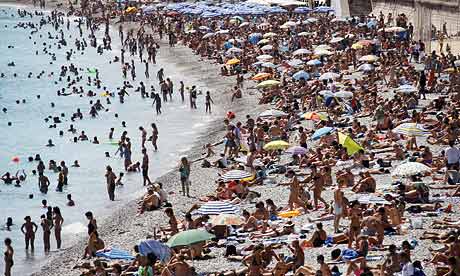
Marks in the Margin will join most Europeans and be on a holiday break (vacanze estive) for the rest of the summer. I hope you enjoy your summer and have a chance to read a good book or two.
 Three days ago on the streets outside the apartment I am renting in Florence there were no longer any cars whizzing by. Indeed, barriers manned by the Carabinieri were set in place that prohibited cars, taxis, trucks, buses, scooters, and motorcycles from entering the area. It was strangely weird and so very quiet and it remains so. Something seems missing, as if everyone has fled the city.
 For years I taught and did research in experimental social psychology. In my day, the field emphasized the situational determinants of behavior, perhaps best exemplified by the studies of Stanley Milgram on obedience and disobedience to authority and Philip Zimbardo on behavior within simulated prisons.
 It is the city itself—the city understood as a self; as a whole, a miraculously developed design. It is the city as what Italians call an insieme, an all-of-it-together. R.W.B. Lewis
 I’d like to invite you on a tour of an Italian retreat for writers, Santa Maddalena, located in the heart of Tuscany about a half-hour from Florence. It was the home of the writer Gregor Von Rezzori and his wife. When he died, she established the Santa Maddalena Foundation that offers visiting fellowships to four writers each year, as well supporting the Writers Festival described in my last two posts.
 Zadie Smith was the featured speaker (Lectio Magistralis) at the Writers Festival (Festival degli Scrittori) I attended in Florence the other day. It was an odd presentation as we were given a pamphlet of her talk upon arriving that I was halfway through as she began reading it, word-by-word.
  I wanted to describe the world, because to live in an undescribed world was too lonely. Nicole Krauss
 We live in an age when private life is being destroyed.
 I finally succumbed the other day and bought an e-reader—the iPad 2. It is my fourth (previously 1 Kindle and 2 iPads, each returned) attempt to come to terms with one of these gadgets.

 What is the difference between an original work of art and a copy? Can one put the same value on them? If not, why not? Does the distinction even matter? These are the questions initially raised in the movie Certified Copy and, on one interpretation the central theme of the film.
 Each June, as the winter continues for what seems forever, I make plans to visit Italy. In the beginning, it was the single event that kept me going through the winter. Now I wonder if it will be the last time. It is also a chance to recharge the muse after finishing a project and I begin floundering around for the next one.
 I continue to read experiments from the various branches of psychology. And they continue to mystify me. Who do they apply to? What is one to make of these generalizations derived from incomprehensible statistical analyses? When examined closely, the differences between conditions or individuals are due to multiple factors and relatively small, albeit statistically significant. What kind of game is this statistical analysis anyway?
  How do you react when a prediction you have made is not confirmed? Do you discount the evidence, look instead for supporting data, or revise your belief while you seek further support?
 They met in Rome through a mutual friend. They were both in their sixties now, Adam, a musician, was there while his daughter was taking a master violin class, Miranda, an epidemiologist for a conference and solo vacation. They had been former lovers, first loves who were certain to be married until their relationship was shattered when Adam betrayed Miranda. Later we learn Miranda acted similarly.
  Recently a friend sent me an essay she wrote about the importance writing has meant to her throughout her life. It is a profound and moving testament. The essay, Reflections on the Writing Life, was an address she delivered on the 72nd anniversary of Kristallnacht and dedicated to Hannah Senesh, a Hungarian Jew, who was murdered by the Nazi’s in 1944 at the age of 23. She begins by quoting Senesh:
 Julius is his name. He is from Nigeria and has lived in the United States since 1992. His father, a German, died when Julius was young and he is estranged from his Nigerian mother. He has done well in this country, graduating from medical school and is about to complete his psychiatric residency. He is also widely cultured, devoted to classical music, photography, and literature. And he is the central character in Teju Cole's remarkable debut novel Open City.
 Ulysses
 “I feel I could not possibly live without writing, even if only for myself, in my diary…A thought that is not put on paper is as if it had never been born. I can only truly grasp a thought when I’ve expressed it in writing.” Hannah Senesh
 The other night I went to cafe here in Honolulu that I had been hoping to visit before leaving. I entered, was politely seated, handed the menu, and decided what I wanted.
  A reader of the blog I wrote on Monday commented that Locke’s indexing method isn’t as complicated as I made it appear. This reader is a librarian so perhaps that should make sense, although she does go on to say, “The complicated part is consistent taxonomy so that every time a certain topic occurs you call it the same thing. You'd think this would be easy but it's not.” Her comment led me to look more closely at just how Locke did it.

